...

Chronic and Invisible Illness Therapy

Just like its name suggests, invisible illnesses are not visible to the human eye. 

Conditions like Arthritis, Crohn’s Disease, Lupus, as well as every mental disorder out there cannot be easily seen and therefore are sometimes harder to understand.

This can be isolating. Sometimes, even more so than visible illnesses.

Why is this?

Because our society is obsessed with the physical. We love to put things in arbitrary boxes to feel a false sense of control. 

If we can’t see it, touch it, taste it, or hear it, then we have trouble making sense of it.

And we tend to fear or question what we can’t make sense of.

But, one thing that’s clear: we are living in a time where there are lots of shifts happening and conversations being had surrounding invisible illnesses.

And this is so important because the more we talk about invisible illnesses, the more we learn, accept, and embrace them.

Our trained invisible illness specialists are here to help you accept your condition and navigate the cards that you’ve been dealt.

There are many aspects of our lives that can change when we’re living with an invisible illness.

From a biological standpoint, our health comes into question, which affects daily abilities that most people take for granted.

Invisible illness can affect every aspect of your life, from talking and walking to running and getting dressed.

From a psychological view, the experience of a chronic or mental illness can require us to dramatically change your lifestyle.

Which understandably can take a real hit to our mental well-being and self-esteem.

Invisible illness can affect everything from the small stuff to the big stuff.

That means the complexities of having a chronic or invisible illness must be explored through many angles.

And that’s exactly what our therapists do.

Book a Free Call

We’re so confident in our extraordinary therapists that we guarantee you’ll love your match – or your money back.

book-a-call

Want to talk?

At My LA Therapy, our highly-vetted Anxiety experts are selected not only for their clinical acumen but for who they are.

want-to-talk

Therapy for Young Adults with Invisible and Chronic Illness

Living with an invisible illness can negatively impact your sense of independence and self-control. 

Especially if you’re a young adult, expected to be at the pinnacle of high activity, productivity, and growth. 

From the ages of 18 to 30, people tend to launch their careers, get married, begin families of their own, and go through other important milestones.

When a chronic condition is thrown into the mix, it can complicate the process of how we can achieve our aspirations and get what we want out of life.

At a time when we might usually direct our energy towards accomplishing these life goals, a chronic or invisible illness may require us to allocate more of our inner resources to cope with our condition.

In society, it is generally uncommon to hear the words “young adult” and “chronic illness” used in the same sentence. 

However, sadly, there are a lot more young adults suffering from chronic illnesses than ever before.

Delivering Healing for Invisible Illness in a Meaningful Way

When it comes to therapy, it’s important to uncover your personal experience and how you as an individual make sense of your condition. 

The degree of your illness, and how it alters your lifestyle, may reflect more on your perceptions and beliefs about the disease than the disease itself.

Having a strong sense of identity can protect you and allow you to accept yourself and find greater resiliency and hope. 

Having a positive belief system can be a protective factor when it comes to our health

That’s where we come in. 

We use a variety of research-proven techniques to help you develop greater resiliency, confidence, and hope

Integrating somatic, cognitive-behavioral, and psychodynamic approaches, we help you transform your limiting belief systems and harmful mental attitudes so that you can become empowered to create the life you want, regardless of your condition. 

Developing greater resiliency and positive beliefs systems helps us achieve identity acceptance and protection in the face of stigmatizing conditions.

Through our work together, we can help you overcome self-consciousness, and develop meaningful connections with others. 

We will help you outline a roadmap to healing and implement strategies to achieve your goals. 

Invisible illness can have a substantial impact on your emotional life, lifestyle, education, self-esteem and social relationships, and physical well-being. 

You might find yourself isolating from friends, or even overly depending on another person. 

Research has indicated, however, that this can change based on establishing healthy coping strategies and changing your outlook on the future. 

That’s where we step in.

Talking about your illness, especially about your fears and emotions, can help you deal with the diagnosis and move forward in life with a healthier perspective.

When young adults start to build a new life that incorporates their illness, they make physical and emotional adaptations and constantly revise their assumptions of the world

The longer the time after diagnosis, the better your adjustment to ‘normal’ life.

But it’s important to remember, even when you come to accept your condition, it’s normal to experience times of grief for years post-diagnosis.

That’s why it’s beneficial to continue therapy to reframe your understanding of how to live with your invisible illness.

We are here to help you on your journey of acceptance so you can reclaim the fulfilling life you deserve.

Our Invisible Illness Therapy Methods

Therapy can successfully improve your life by helping you minimize the anxiety in your life, identify and change underlying thought and behavioral patterns that contribute to your struggles, and provide you with strategies to decrease discomfort while restoring an overall sense of peace.

See the About Therapy page for a deeper look into this process. 

Our evidence-based, scientifically proven interventions are demonstrated by research to be effective in addressing mental health conditions associated with chronic and invisible illness such as depression, anxiety, and addiction.

Learn more about our empirically based therapy modalitiesby visiting our Methods page.

Invisible Illness Therapists

What Our Clients Say

I am blown away! I don’t write testimonials, unless I have been extremely moved by something. I was blessed to...

I am blown away! I don’t write testimonials, unless I have been extremely moved by something. I was blessed to work with Brooke on a single session, and before this I was in therapy on and off with multiple therapists for the last 20 years of my life. Brooke was able to do more in one session than many years of work with my previous therapist. She has the true gift of great insight and compassion while also getting straight to the heart of your blind spots and unconscious issues in a way that has truly changed my life.

Skyler J.

There are people who are good at their work there are people like Brooke: who are born to do it....

There are people who are good at their work there are people like Brooke: who are born to do it. I cannot recommend Brooke more highly. I can only imagine where I would be today if I had started working with her years ago. From the beginning of our session, she knew exactly what tools and questions that would work for my particular psychology and my personal experience. No other therapist has been able to do that or anything close.

What I also really appreciate from our session is Brooke's ability to go directly to the source of the issue while also keeping a very gentle and kind energy with me. I felt very seen, understood, and supported. Everything and more that I could have ever asked for from a therapist. I have a severe trauma history and complex issues she was able to immediately identify and help. If she could help me, I know she can help you too.

Taylor E.

You did more in 45 minutes than my last therapist did in a year.

You did more in 45 minutes than my last therapist did in a year.

Jamie

With your help, I've finally started to understand that while my vivid imagination often wants to create terrifying monsters under...

With your help, I've finally started to understand that while my vivid imagination often wants to create terrifying monsters under the bed, in a lot of cases those monsters are nothing more than a heap of decidedly less-terrifying laundry I've avoided for too long that just needs to be aired out and put away. Which is definitely a lot easier than monster slaying. Thank you for shedding light in the dark places I was too afraid to face alone.

Morgan B.

I am extremely fortunate to work with Sydney, who is helping me create real internal change. The talent to listen...

I am extremely fortunate to work with Sydney, who is helping me create real internal change. The talent to listen well is Hall of Fame stuff, and she has that. She then follows with questions, strategies that are organic to the moment. I have come to believe that deep, radical, if occasionally deeply painful change ... and, then, healing can happen. I'm just at the lip of that last part - but would not have gotten there, AT ALL, without Sydney

Ric K.

The best therapist ever! Life-changing 🙂

The best therapist ever! Life-changing 🙂

Catherine H.

Right now, the work is changing my life, sometimes in inches, sometimes in miles.

Right now, the work is changing my life, sometimes in inches, sometimes in miles.

Ric K.
We find you the perfect therapist.

Guaranteed.
We find you the perfect therapist – or your money back.
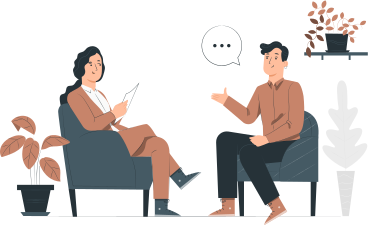
Therapist and client in a counseling session.